Schumer Backs Democratic Party’s Progressive Push as 2026 Midterms Take Shape
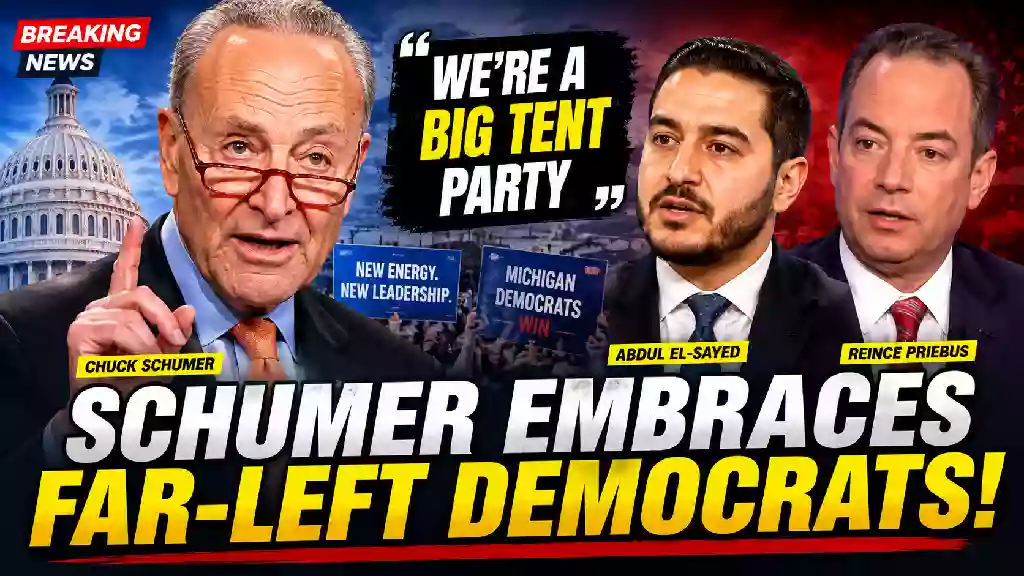
Chuck Schumer defends a broad Democratic Party strategy as progressive politics and the 2026 midterm elections take center stage.
Schumer Backs Democratic Party’s Progressive Push as 2026 Midterms Take Shape
Chuck Schumer Promotes a “Big Tent” Democratic Party
Senate Democratic Leader Chuck Schumer is defending a broad Democratic coalition as the party prepares for the 2026 midterm elections, arguing that Democrats can bring together voters and candidates with different views.
In comments highlighted in the source, Schumer described Democrats as a “big tent party” and said members do not have to share identical positions on every issue. He pointed to concerns over costs, the economy and the Trump administration as reasons he believes Democrats can compete successfully in key states.
Schumer also expressed confidence about Democratic prospects in Michigan, highlighting Abdul El-Sayed as a candidate who has brought what he described as new energy and talent to the party.
His comments come as Democrats face an ongoing debate over how strongly the party should embrace progressive candidates and policies heading into the next major election cycle.
Michigan Becomes a Test for Democratic Strategy
Michigan is emerging as an important part of the Democratic Party’s broader electoral strategy. Schumer’s support for El-Sayed has drawn attention because of the candidate’s progressive political positioning.
The discussion surrounding Schumer’s comments questioned whether embracing candidates farther to the left can help Democrats energize their base while still appealing to moderate voters and independents.
Reince Priebus, a former Republican National Committee chairman and former Trump chief of staff, argued during the discussion that the Democratic Party’s political “edges” are increasingly influencing its center.
The source also points to tensions between Schumer and some Democratic candidates. Florida Democrat Angie Nixon was cited as another example of a candidate who won while saying she would not support Schumer.
Democrats Face a Debate Over Party Direction
A central theme of the discussion is the Democratic Party’s struggle to define its political identity.
Priebus argued that Republicans have benefited from Donald Trump’s ability to generate political energy and bring different parts of the Republican coalition together. He contrasted that with Democrats, who he said are relying on progressive figures and political issues to generate enthusiasm.
That raises a strategic question for Democrats: Can progressive energy help the party win competitive elections without creating difficulties with voters who hold more moderate views?
For Democratic leaders, finding the right balance could become increasingly important as the 2026 midterms draw closer.
Wisconsin and Hispanic Voters Highlight the Challenge
The discussion also turned to Wisconsin and the difficulty of developing a message that appeals to voters across different communities.
Milwaukee was presented as an example of a diverse electorate with concerns that may differ from those of progressive voters in other parts of the state. The discussion specifically referenced public safety and economic issues while also examining how cultural issues could affect Democratic support among Hispanic voters.
The source further connected those concerns to states such as Texas, where Hispanic voters represent an important part of the electorate.
The broader challenge is whether Democrats can maintain enthusiasm among progressive voters while also addressing issues that resonate with moderate, working-class and independent voters.
Economy, Inflation and Crime Could Shape the Midterms
The 2026 midterm elections are likely to place significant attention on issues affecting voters’ daily lives. The discussion identified border security, crime, the economy and inflation as issues that could influence voters in closely contested congressional districts.
The source argues that midterm elections often involve a smaller and more politically engaged electorate than presidential elections. It also suggests that campaigns can spend enormous amounts of money attempting to influence relatively small numbers of voters in competitive races.
That makes campaign messaging, voter outreach and turnout operations particularly important.
Money, Messaging and Campaign Mechanics
The discussion concluded that the 2026 midterms could be extremely close, with three factors identified as especially important: money, messaging and campaign mechanics.
Campaign mechanics include voter identification, absentee-ballot programs and efforts to contact and mobilize voters. While these activities may receive less attention than major political speeches or campaign controversies, they can play a significant role in closely contested races.
As Schumer promotes a “big tent” approach and Democrats continue debating the party’s direction, the 2026 midterm elections could provide an important test of whether progressive energy can translate into electoral victories.
#ChuckSchumer #Democrats #2026Midterms #MidtermElections #USPolitics #MichiganPolitics #WisconsinPolitics #DemocraticParty #ProgressivePolitics #Election2026