OHFA’s Latest Board Agenda Raises New Questions About the HOME Program Suspension
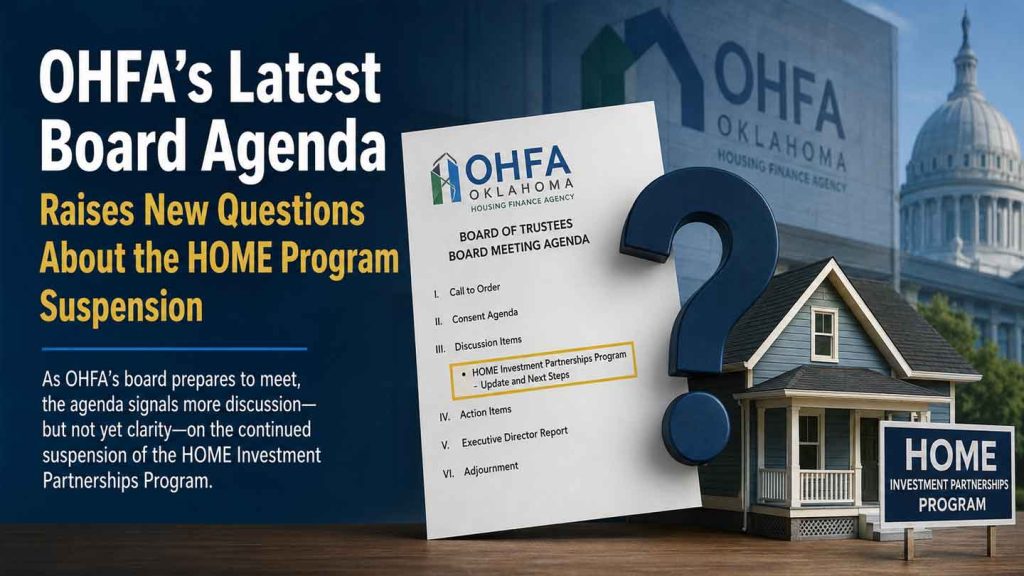
OHFA’s Latest Board Agenda Raises New Questions About the HOME Program Suspension
The Reason for the Suspension Has Disappeared — But the Suspension Remains
For months, Oklahoma communities, developers, nonprofits, and local governments have waited for the Oklahoma HOME Investment Partnerships Program to reopen. Yet despite the pending legislative issue that OHFA cited as justification for suspending the program now being effectively dead, the recently posted May Board agenda still does not include any item to reinstate HOME funding.
That absence raises serious questions about whether the suspension was ever truly about legislative uncertainty in the first place.
At the March Special Board Meeting, agency leadership emphasized that the HOME program suspension was “temporary” and tied directly to pending legislation. Despite verbal staff comments that the suspension was temporary – nowhere in the official Board Resolution is there mention that this is a “temporary” action. The actual Board Resolution does not match staff testimony at all. Board members and staff indicated that if circumstances changed — including if the legislation failed to pass or if the emergency clause was removed — the Board could simply call an emergency meeting and resume normal program operations. On April 21, 2026, one of these circumstances did change when the Senate Committee Substitute removed the emergency clause.
Now that legislation is no longer moving forward in the form that OHFA claimed required an immediate shutdown of the HOME program, the core justification for suspending the program has disappeared. But instead of moving quickly to restore funding access for communities across Oklahoma, the newly posted May Board agenda contains no action item to reopen the program, no discussion of reinstatement, and no public roadmap for how or when applicants can move forward.
A Broken Promise to Rural Oklahoma
The HOME program is not a minor administrative function. It is one of the primary tools rural communities rely on to build affordable housing, rehabilitate homes, and support local development projects.
While large entitlement cities such as Oklahoma City, Tulsa, Norman, and Lawton receive direct federal housing allocations, most rural communities depend entirely on OHFA to administer these resources. When OHFA freezes the program, rural Oklahoma effectively loses access to one of its only major affordable housing development tools.
The timing could not be worse. Housing shortages continue across the state, construction costs remain high, and many communities are still recovering from severe weather and tornado damage that has only increased the demand for affordable housing options.
Every month the program remains frozen creates additional uncertainty and delay for communities that already struggle to attract housing investment.
What OHFA Said at the March Special Meeting
The March Special Board Meeting created a clear public expectation that the suspension would be lifted once the legislative concern was resolved.
During that meeting, OHFA leadership repeatedly suggested that reopening the program would be straightforward and could happen quickly through Board action if circumstances changed. The agency specifically referenced the possibility of calling an emergency meeting if the bill failed or if the emergency clause was removed.
That is precisely why the May Board agenda is so concerning.
The absence of answers only deepens concerns about transparency and accountability within the agency.
Part of a Larger Pattern
This latest development does not exist in isolation. It fits within a broader pattern of growing concern surrounding OHFA’s governance and oversight structure.
Questions have already been raised regarding the agency’s reserve practices, fair housing concerns, resistance to legislative direction, and its unusually independent structure as a public trust. Critics have argued that OHFA operates with limited meaningful oversight despite controlling significant statewide housing resources.
The HOME Program suspension intensified those concerns for rural Oklahoma because it demonstrated how much unilateral authority the agency can exercise over critical housing programs with little external accountability.
Now, with the legislative issue effectively gone and the freeze still continuing, the situation becomes even harder to justify publicly.
The fact that reinstatement is absent from the Board agenda inevitably raises a difficult question: was the suspension ever truly intended to be temporary?
Oklahoma Communities Deserve Answers
If OHFA truly intended the freeze to last only until the legislative issue was resolved, reopening the HOME program should now be a priority. At minimum, the Board should publicly explain:
- Why reinstatement is not on the current agenda;
- What conditions still allegedly justify the freeze;
- Whether an emergency meeting will be called;
- And when rural communities can realistically expect the HOME program to resume.
These are not abstract policy questions. The consequences are real and immediate for Oklahoma families and communities struggling with housing shortages. Every unanswered question further erodes public trust.
This issue is not about one bill or one Board agenda. It is about stewardship, accountability, and whether Oklahoma’s housing programs are being administered in a way that genuinely serves the people who depend on them most.
And based on the latest Board agenda, those questions are only growing louder.