Comer Opens Contempt Proceedings Against the Clintons Over Epstein Subpoenas
Comer opens contempt-proceedings against the-Clintons over Epstein subpoenas.
Comer Opens Contempt Proceedings Against the Clintons Over Epstein Subpoenas
In a dramatic opening statement before the House Committee on Oversight and Government Reform, Chairman James Comer formally advanced resolutions recommending that Congress hold former President Bill Clinton and former Secretary of State Hillary Clinton in contempt of Congress. The action stems from their refusal to comply with subpoenas issued as part of the committee’s investigation into the federal government’s handling of the Jeffrey Epstein and Ghislaine Maxwell criminal cases.
Comer’s remarks set a serious tone, emphasizing that the committee’s move was not symbolic or partisan, but a necessary step to preserve congressional authority and ensure accountability—regardless of political stature.
“Subpoenas Are Not Suggestions”
Chairman Comer made clear from the outset that congressional subpoenas carry the force of law. “They are not mere suggestions,” he said, stressing that compliance is mandatory, even for former presidents and cabinet officials.
According to Comer, both Clintons were legally required to appear for depositions before the committee and declined to do so. Their refusal, he argued, left Congress with little choice but to pursue contempt proceedings.
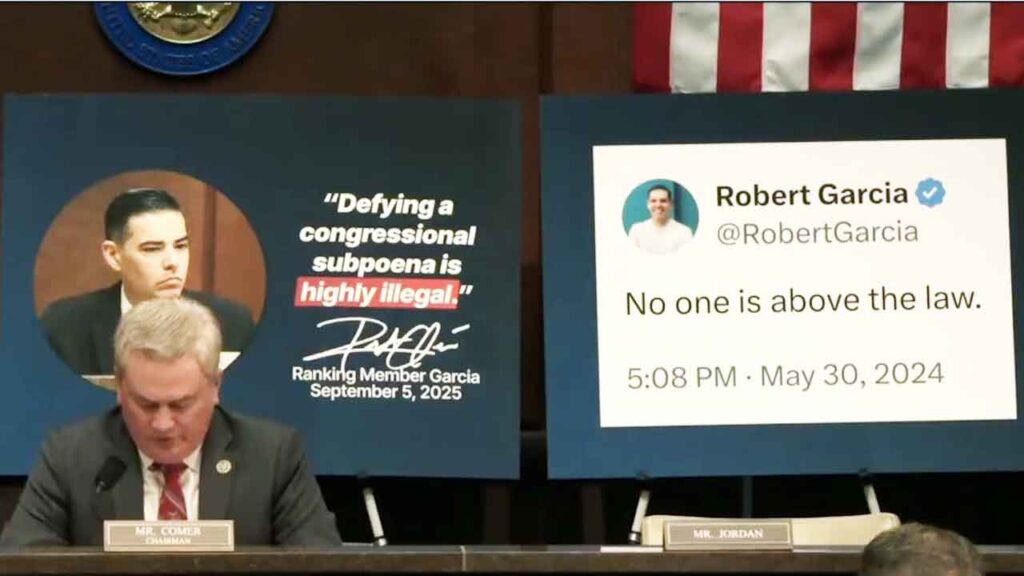
He underscored the point by quoting the committee’s Democratic ranking member, who previously stated that defying a congressional subpoena is “highly illegal” and that “no one is above the law.” Comer argued that those principles must apply evenly—or not at all.
A Bipartisan Subpoena, Issued in Good Faith
Comer emphasized that the subpoenas were not the product of partisan maneuvering. Six months earlier, Republicans and Democrats on the committee’s Federal Law Enforcement Subcommittee unanimously approved deposition subpoenas for the Clintons by voice vote.
The subpoenas were issued more than five months ago as part of an investigation into how Epstein’s sex trafficking operation was handled by federal authorities—and how Epstein allegedly used wealth, influence, and relationships with powerful individuals to avoid scrutiny for years.
The chairman stated that the committee acted in good faith, offering scheduling flexibility and ample opportunity for cooperation. Instead, he said, the response from the Clintons’ legal team amounted to “repeated delays, excuses, and obstruction.”
Why Written Statements Were Rejected
A key argument raised by the Clintons’ attorneys was that other high-ranking officials were allowed to submit written statements instead of appearing in person. Comer addressed this head-on.
Former attorneys general and FBI officials were permitted to submit written responses, Comer said, because they lacked personal relationships with Epstein and did not recall information directly relevant to the investigation. By contrast, the Clintons fall into what Comer described as a “fundamentally different category.”
The committee, he said, possesses extensive documentation tying both Clintons to Epstein and Maxwell, including photographs, flight log records, invitations, and other materials. During the hearing, Comer displayed some of these images as evidence that the Clintons’ testimony could not be adequately captured through brief, written statements.
Federal courts, Comer added, have consistently ruled that witnesses may not dictate the terms of congressional inquiries. The subpoenas explicitly required in-person depositions, and the committee repeatedly informed the Clintons that written statements would not suffice.
Epstein, Accountability, and Legislative Purpose
Beyond individual culpability, Comer framed the investigation as legislative in nature. Understanding Epstein’s trafficking network, he argued, is essential to strengthening federal laws aimed at combating human trafficking and protecting victims.
“Their testimony may inform how Congress can do better,” Comer said, pointing to the broader policy implications of the case. He stressed that enforcement of subpoenas is critical to Congress’s ability to investigate, legislate, and prevent future abuses of power.
Accusations of Political Deflection
Comer also accused Democrats of attempting to divert attention from the Clintons’ refusal to comply by proposing contempt proceedings against Attorney General Pam Bondi. He argued the situations are not comparable.
According to Comer, the Department of Justice is producing documents, albeit more slowly than lawmakers would like, largely due to efforts to protect victims’ identities. The Clintons, by contrast, have “flatly refused to appear at all,” despite clear warnings that contempt proceedings would follow.
A Test of Equal Justice
In closing, Comer framed the vote as a defining moment for Congress. Upholding investigative authority, he said, is essential to maintaining public trust and demonstrating that justice applies equally—“regardless of position, pedigree, or prestige.”
He called on members of both parties to support the contempt resolutions, warning that failure to do so would expose hypocrisy and further erode confidence in congressional oversight.
As the committee moves forward, the outcome of these resolutions could set a precedent not only for this investigation, but for how Congress enforces its authority when powerful figures choose defiance over compliance.
#ContemptOfCongress #HouseOversight #EpsteinInvestigation #EqualJustice #CongressionalAuthority
RELATED ARTICLES
WORSE THAN WE THOUGHT: Jim Jordan Erupts Over FBI’s Assault on Democracy
Allegations Swirl Around Rep Ilhan Omar Amid Minnesota Fraud Probes and Net Worth Questions