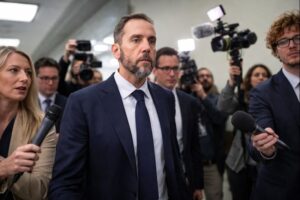
Border Patrol Commander Sounds Alarm on Minnesota Detainers and Sanctuary Resistance
Border Patrol Commander Sounds Alarm
“I’ve Never Seen This Before”: Border Patrol Commander Sounds Alarm on Minnesota Detainers and Sanctuary Resistance
A blunt warning from a senior Border Patrol official is drawing renewed national attention to the growing clash between federal immigration enforcement and local sanctuary-style policies. In a recent interview, Border Patrol Commander-at-Large Greg Bovino described conditions in Minnesota—particularly Minneapolis—as unlike anything he has witnessed in his career, citing open resistance from local leadership and hundreds of criminal illegal aliens being shielded from federal custody.
According to Bovino, the situation is not theoretical. It is unfolding in real time, with public safety consequences that he says should alarm taxpayers across the country.
1,360 Immigration Detainers—and Still Being Held Locally
At the center of the controversy is a striking statistic: 1,360 illegal aliens currently sitting in Minnesota jails and prisons with active immigration detainers. These detainers signal that federal authorities—ICE and Border Patrol—are requesting custody of individuals once they complete local or state proceedings.
“These are exactly the people we’re trying to remove from the United States,” Bovino said. “They’re criminals, they’re here illegally, and Minnesota taxpayers are paying to house them.”
Despite that, Bovino says state and local officials are refusing to turn them over, forcing federal agents to operate under far more dangerous and resource-intensive conditions.
“They’re Standing in Our Way”
Bovino did not mince words when asked whether Minnesota leadership is obstructing federal enforcement.
“Absolutely, they’re standing in our way,” he said.
He explained that Border Patrol, ICE, and allied federal law enforcement agencies are now deployed in large numbers precisely because cooperation has broken down. Instead of controlled handoffs inside secure facilities, agents are forced to locate and arrest criminal illegal aliens in neighborhoods, apartment complexes, and public spaces.
“If they would work with us, things would be a lot easier,” Bovino said. “And most importantly, the taxpayer would be a lot safer.”
Violent Criminals, Including Child Rapists, Recently at Large
Perhaps the most disturbing element of Bovino’s remarks involved the nature of the crimes linked to some of the individuals being protected from transfer to federal custody.
He confirmed that child rapists were walking the streets of Minneapolis as recently as 24 hours before the interview, despite being known to authorities.
“How do leaders support criminal illegal aliens who would do that to a child?” Bovino asked. “There are murderers, terrorists, and other violent offenders. It’s something that’s a mystery to me and to the agents working here.”
For Bovino, the issue goes beyond politics—it strikes at the moral responsibility of government to protect children and vulnerable residents.
A “Non-Permissive Environment” for Federal Agents
When asked whether Minnesota and Minneapolis represent the worst conditions Border Patrol has faced, Bovino described the state as a “non-permissive environment” due to hostile local leadership.
He singled out Minneapolis Mayor Jacob Frey, alleging that city leadership has encouraged local police officers to actively resist Border Patrol agents.
“That one’s new,” Bovino said. “I’ve never seen leadership encourage police to fight federal agents in the street.”
He compared the situation to other sanctuary jurisdictions across the country, naming Illinois Governor J.B. Pritzker, Chicago Mayor Brandon Johnson, and California Governor Gavin Newsom, but said Minnesota has taken resistance to a new level.
Federal Support Has Changed the Game
Despite local opposition, Bovino emphasized that the broader federal environment has shifted dramatically under Donald Trump and Homeland Security Secretary Kristi Noem.
“They’re a dream team to work for,” Bovino said.
That support has had a direct impact on morale among Border Patrol agents, ICE officers, and federal law enforcement partners. Bovino described morale as “extremely high,” driven by the renewed ability to focus on the core mission: removing violent criminal illegal aliens from American communities.
“This is what we signed up to do,” he said. “We’re finally playing the game.”
Early Innings, Bigger Enforcement Ahead
Bovino framed current enforcement actions as only the beginning.
“We’re maybe in the first or second inning,” he said. “There’s a lot more innings to go.”
Looking ahead to 2026, he predicted a significant expansion of enforcement capacity, with thousands more ICE agents and Border Patrol agents deploying both at the border and inside the United States.
The goal, Bovino said, is straightforward: safer cities, a safer homeland, and a border that is once again under control.
Sanctuary Policies Under the Spotlight
The Minnesota standoff highlights a broader national debate over sanctuary policies and the limits of state and local authority. Bovino argued that if local leaders had enforced existing laws and cooperated with federal agencies from the beginning, federal agents would not need to be operating inside cities at all.
“If they had done their jobs and kept the border closed,” he said, “we wouldn’t be here.”
A Defining Moment for Public Safety
For residents far beyond Minnesota, the issue raises fundamental questions: Who is responsible for public safety? Who bears the cost of incarceration? And should local governments be allowed to block the removal of violent criminal illegal aliens?
According to Bovino, the answer is clear.
“We’re securing and protecting this nation,” he said. “And Americans are already seeing the difference.”
#BorderSecurity #ICE #PublicSafety #IllegalImmigration #LawEnforcement
Allegations Swirl Around Rep Ilhan Omar Amid Minnesota Fraud Probes and Net Worth Questions